


Chinese Embassy in Slovenia Publishes an Article on China’s Economic and Industrial Development
On September 10, 2026, Chinese Embassy in Slovenia published an article on Večer, responding to one-sided views such as “China’s domestic demand remains weak” and “Chinese overcapacity flooding world markets”, and aiming to promote a better understanding of China’s economic and industrial development. The full article reads as follows:
Dear Editor,
Thank you for your newspaper’s attention to China’s economic and industrial development. Such coverage helps improve international understanding and cooperation. We would like to share our views on the statements regarding China’s “excess capacity” in the article.
The article mentions that “China’s domestic demand remains weak” and that “excess capacity in Chinese industry is putting pressure on Europe”. In fact, China is not only a major consumer market but also a manufacturing hub. From 2013 to 2024, domestic demand contributed an average of 93.1% to China’s economic growth. In 2025, China’s retail sales of consumer goods were approximately 1.7 times those of the United States, making China the world’s largest consumer market for goods.
For more than a decade, China has been an important engine of global economic growth, accounting for around 30% of global growth. China remains committed to innovation through an open approach. Fast-growing, innovative Chinese companies have delivered returns several times—and in some cases dozens of times—the initial investment. When it comes to the distribution of trade benefits, “the surplus is registered in China, yet the benefits are shared by all”. In 2025, foreign-invested enterprises accounted for 27% of China’s exports and 16% of its trade surplus, with both their trade surplus and profits growing faster than those of domestic Chinese enterprises. Notably, up to 40% of the raw materials used to produce Slovenian exports are sourced from China, underscoring the close economic and trade ties between our two countries.
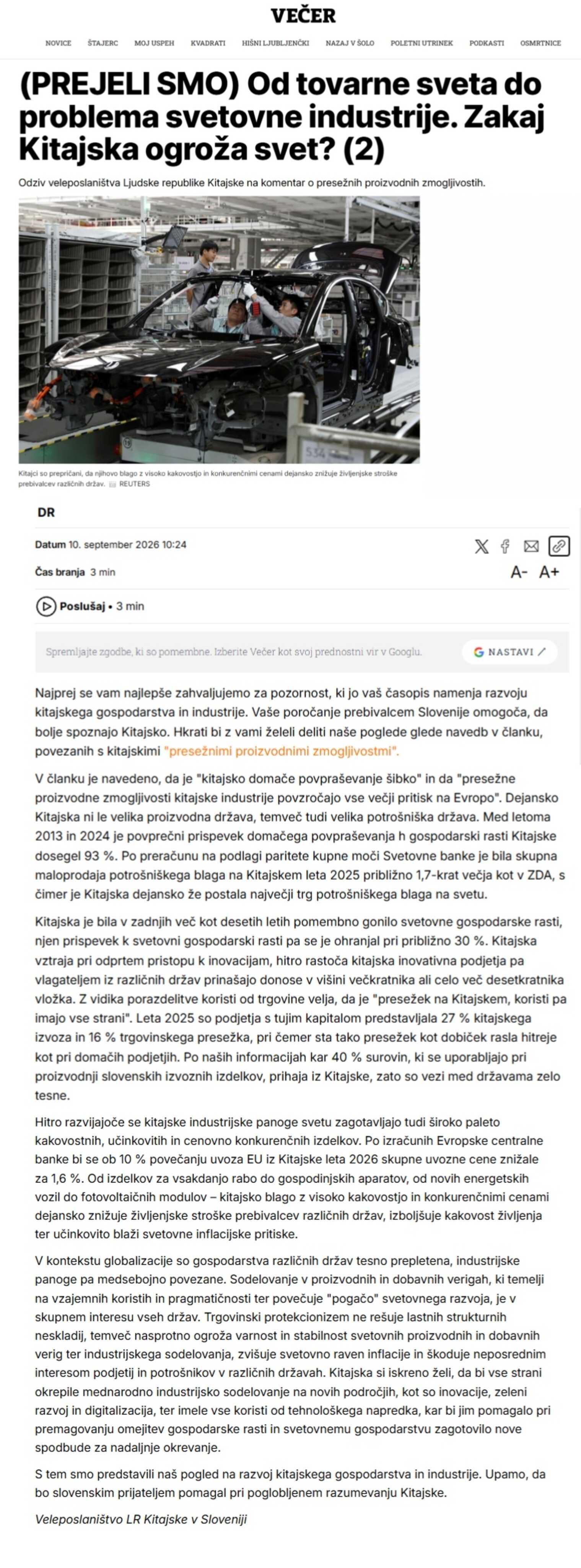
China’s rapidly developing industries also supply the world with a rich array of high-quality, high-performance and cost-effective products. Estimates by the European Central Bank show that a 10% increase in EU imports from China in 2026 would lower the EU’s overall import prices by 1.6%. From daily consumer goods to home appliances, from new energy vehicles to photovoltaic modules, Chinese goods, with their high quality and competitive pricing, have effectively reduced people’s living costs in many countries, improved their quality of life and helped ease global inflationary pressures.
Against the backdrop of economic globalization, economies are deeply intertwined and industries are highly integrated. Pursuing mutually beneficial and pragmatic industrial and supply-chain cooperation to make the pie of global development bigger serves the common interests of all countries. Trade protectionism does nothing to resolve economic problems. On the contrary, it disrupts industrial cooperation and the security and stability of global industrial and supply chains, pushes up global inflation, and harms the interests of enterprises and consumers worldwide. China sincerely hopes that all sides will strengthen international industrial cooperation in emerging fields, including technological innovation, green and low-carbon development, and the digital economy. By sharing the benefits of scientific and technological progress, we can break through growth bottlenecks and inject fresh vitality into sustained global economic recovery.
The above is our interpretation of China’s economic and industrial development. We hope this will help our Slovenian friends gain a deeper understanding of China.
Embassy of the People’s Republic of China in the Republic of Slovenia